
Planning to study in the USA but confused about how to show proof of funds for your F1 visa?
Many students struggle to decide between bank balance, education loan, or self-funding options like FD, mutual funds, and investments.
In this guide, we clearly explain what works, what doesn’t, and how to avoid visa rejection with the right financial strategy.
📌 WHAT IS PROOF OF FUNDS FOR USA VISA?
Proof of funds means showing that you have sufficient financial resources to cover your education and living expenses in the USA.
For an F1 visa, you must show:
✔ Funds for at least 1 year (I-20 amount)
✔ Genuine and verifiable sources
✔ Clear financial planning
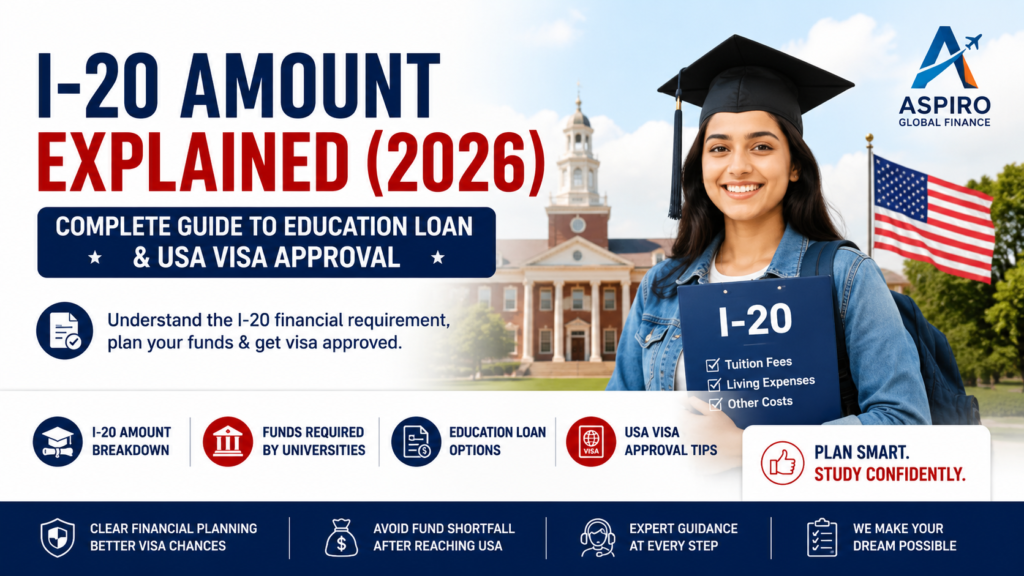
📌 WHAT IS I-20 AMOUNT?
The I-20 amount is issued by your university and includes:
- Tuition fees
- Living expenses
- Insurance
- Miscellaneous costs
👉 Typically ranges between $60,000 to $100,000 per year

📊 TYPES OF PROOF OF FUNDS (VERY IMPORTANT)
Students can show funds using three main methods:
🏦 1. BANK BALANCE (Liquid Funds)
✔ Savings account balance
✔ Current account
Pros:
- Easy to show
- Highly accepted
Cons:
- Requires large upfront cash
- May not be feasible for many families
- Requires proof
💰 2. EDUCATION LOAN (STRONGEST OPTION)
Education loan is one of the most powerful and accepted proof of funds.
✔ Covers full I-20 amount
✔ Shows financial planning
✔ Accepted by visa officers
Key Benefits:
- No need to block huge savings
- Reduces financial stress
- Improves visa credibility
👉 Especially strong when using a US Co-Signer Loan (low interest starting ~2.84%)
📈 3. SELF-FUNDING OPTIONS (Liquid + Semi-Liquid)
You can also show assets along with liquid funds:
✅ Liquid Funds:
- Savings account
- Fixed Deposits (FD)
- Education loan sanction letter
⚠️ Semi-Liquid Funds (Supportive only):
- Provident Fund (PF)
- Mutual Funds (MF)
- Shares / Stocks
- Bonds
- LIC surrender value
👉 Important:
- These are not fully accepted as primary proof
- Must be combined with liquid funds or loan
⚖️ BANK BALANCE vs EDUCATION LOAN (COMPARISON)
| Factor | Bank Balance | Education Loan |
|---|---|---|
| Liquidity | High | High |
| Upfront cash needed | Very High | Low |
| Visa credibility | Good | Very Strong |
| Covers full I-20 | Not always | Yes |
| Financial planning | Weak | Strong |
👉 Conclusion:
Education loan provides better structure + stronger visa profile
🚫 COMMON MISTAKES (CAUSE OF VISA REJECTION)
Avoid these:
❌ Showing only partial funds
❌ Relying only on PF / MF / shares
❌ Sudden large deposits
❌ Unclear source of funds
❌ No proper loan planning
🎯 HOW EDUCATION LOAN HELPS AVOID VISA REJECTION
A properly structured loan:
✔ Covers full financial requirement
✔ Shows long-term planning
✔ Reduces dependency on savings
✔ Builds strong visa confidence
👉 This is why many successful applicants prefer loan + partial savings strategy
🔗 IMPORTANT: EXPLORE LOAN OPTIONS
To understand loan types in detail:
👉 US Co-Signer Loan Guide (2.79% Interest)
👉 USA vs India Loan Comparison
💼 HOW ASPIRO GLOBAL FINANCE HELPS
At Aspiro Global Finance, we help students:
✔ Compare all loan options
✔ Get lowest interest rates
✔ Structure visa-ready funding
✔ Fast approvals
✔ Cashback benefits
📞 CALL TO ACTION
Confused about your proof of funds?
👉 DM “USA” on Instagram or connect via website to get a free eligibility check – Whatsapp
❓ FREQUENTLY ASKED QUESTIONS (SHORT + POWERFUL)
1. Is bank balance compulsory for USA visa?
No. You can show an education loan + partial savings instead of full bank balance.
2. Can I show PF, mutual funds, or shares?
Yes, but only as supporting funds, not primary proof.
3. Can education loan cover full I-20 amount?
Yes. Most lenders provide loans covering 100% cost of attendance.
4. Is visa rejection possible with education loan?
No, education loan does NOT cause visa rejection.
In fact, a properly structured loan improves your visa chances because it shows financial clarity and planning.
5. What is the safest way to show proof of funds?
👉 Best combination:
Education Loan + Partial Liquid Savings
Related Reading from Aspiro Global Finance
Living Expenses in USA for Indian Students — Calculate the total cost of studying and living in the USA.
I-20 Amount Explained — Understand how proof of funds and I-20 requirements are connected.
US Co-Signer Education Loan Guide — Learn how sanctioned education loans can be used as financial proof.
US Co-Signer Loan vs Indian & No-Co-Signer Loans — Compare funding options before arranging proof of funds.
MBA Loan Guide 2026 — Financial planning for MBA students pursuing global business education.
Fall 2026 US Visa Crisis — Understand the latest visa concerns and preparation strategies.