

In this guide, we explain the most important US student visa rejection reasons 2026 applicants should understand before attending their F1 visa interview.
For thousands of Indian students, getting admission to a U.S. university is no longer the most stressful part of the study abroad journey.
Getting a visa appointment — and getting approved — has become the bigger challenge.
Over the last few months, students across India have reported:
- F-1 visa slots disappearing within minutes
- Long appointment delays
- Growing uncertainty around approvals
- Increased scrutiny during interviews
- Confusing information circulating across social media
As a result, one question is being searched more than ever:
Why are so many students getting rejected for U.S. student visas in 2026?
The answer is more complicated than most people think.
This article breaks down what is actually happening in the U.S. student visa market, the real reasons behind F-1 visa refusals, and what Fall 2026 students should understand before attending their interview.
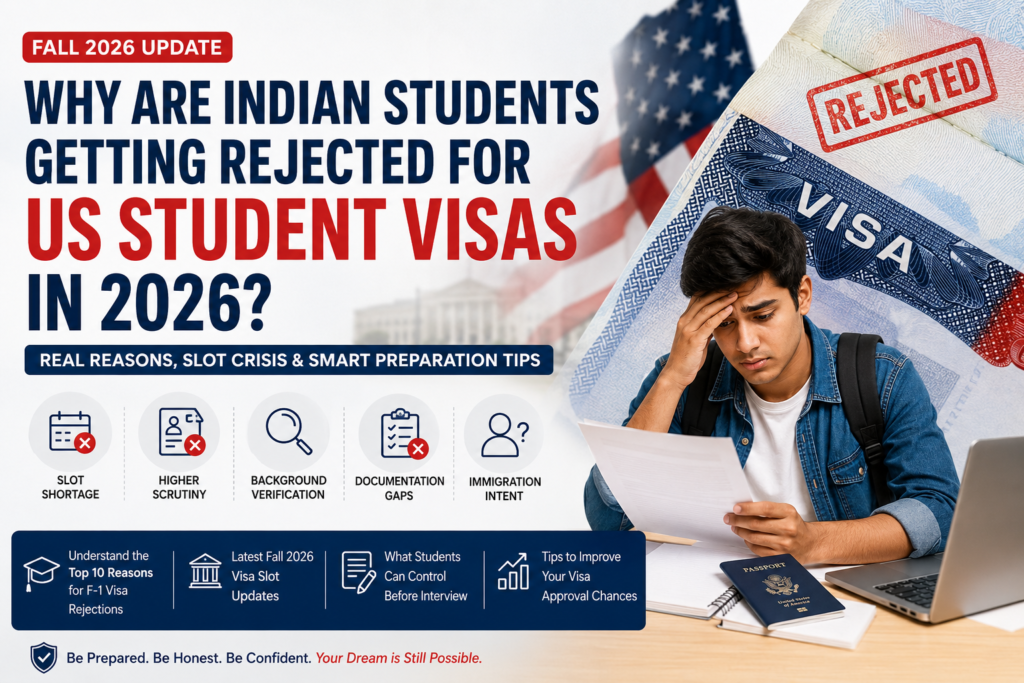
What Is Happening With U.S. Student Visas in 2026?
The United States remains the most preferred destination for higher education among Indian students.
However, 2025 -2026 has become one of the most challenging years in recent memory for visa processing.
Students are currently facing:
- Limited visa appointment availability
- Increased competition for interview slots
- Enhanced background verification
- Greater scrutiny of student profiles
- Rising financial documentation checks
- More detailed immigration intent assessment
The situation has become particularly stressful for Fall 2026 students because many already have:
- University admits
- I-20s
- Housing arrangements
- Tuition deposits paid
But are still waiting for interview appointments.
According to multiple reports, F-1 visa slots released across India are being booked within minutes due to extremely high demand and limited availability.
Source:
U.S. visa slot shortages and rapid booking trends have been widely reported by multiple education and visa tracking platforms in 2026.
Are U.S. Student Visa Rejections Really Increasing?
This is where students must separate facts from social media rumors.
Several international education reports indicate that F-1 visa refusals have increased significantly over recent years.
According to analysis cited by ICEF Monitor, one of the most widely followed international education industry publications, refusal rates among Indian F-1 applicants increased sharply in 2025. Some datasets referenced by the report indicated refusal levels above 60% for Indian applicants.
However, students should understand that different organizations measure refusal rates differently.
Some reports focus on:
- Refusal percentages
- Approval percentages
- Monthly issuance numbers
- Specific countries
- Specific time periods
Because of this, exact percentages may vary depending on the source.
What is clear is that:
Visa scrutiny has increased, and students are facing a more competitive approval environment than they did a few years ago.
Additional reporting suggests worldwide F-1 refusal rates have been trending upward over the last several years.
Why Are Visa Slots So Difficult to Get Right Now?
One of the biggest misconceptions among students is assuming that appointment shortages automatically mean higher rejection rates.
These are separate issues.
The slot crisis is primarily linked to:
Increased Demand
India continues to send one of the largest international student populations to the United States.
Processing Backlogs
Multiple reports indicate visa processing capacity was affected by stricter verification and screening measures introduced during late 2025 and early 2026.
Additional Vetting Measures
Several reports indicate expanded social media screening and verification requirements contributed to appointment slowdowns.
As a result, many students are competing for a limited number of interview appointments.
Top 10 US Student Visa Rejection Reasons 2026
1. Weak Career Logic
Visa officers want a logical academic story.
They evaluate:
- Previous education
- Work experience
- Future goals
- Chosen degree
If the journey appears random or poorly explained, concerns arise.
2. Unclear Reason for Choosing the Program
Students often know the university name.
But many cannot explain:
- Why this specific program?
- What skills will it provide?
- How does it connect to future goals?
That weakens credibility.
3. Immigration Intent Concerns (214b)
One of the most common refusal categories remains Section 214(b).
The officer must believe that:
The primary purpose is education.
Students who focus entirely on U.S. jobs, settlement, or immigration plans may unintentionally create concerns.
4. Poor University Selection Strategy
Not all admits carry equal weight.
Visa officers may assess:
- Program quality
- Academic fit
- University reputation
- Student progression
A profile that appears inconsistent with the chosen institution may attract additional questioning.
5. Scripted Interview Answers
This is becoming increasingly common.
Students memorize consultant-prepared responses.
Visa officers conduct thousands of interviews every year and can quickly identify rehearsed communication.
Natural understanding performs better than memorization.
6. Unexplained Academic or Career Gaps
A gap itself is not a rejection reason.
An unexplained gap is.
Students should be able to explain:
- Employment
- Certifications
- Projects
- Skill development
during any inactive period.
7. Financial Inconsistencies
Contrary to popular belief, rejection is often not about having “less money.”
It is about having an unclear financial story.
Common concerns include:
- Large unexplained deposits
- Temporary funds
- Contradictory sponsor information
- Inability to explain funding structure
8. Lack of Understanding of One’s Own Application
Students should understand:
- SOP
- University selection
- Funding structure
- Academic goals
A visa officer expects applicants to understand their own application.
9. Misrepresentation or False Documents
Providing inaccurate information can create serious consequences.
Students should avoid:
- Fake employment documents
- Incorrect financial records
- Misleading academic information
Accuracy matters more than appearing perfect.
10. Multiple Small Weaknesses Together
Most refusals happen because several concerns appear simultaneously.
For example:
- Weak university choice
- Unclear goals
- Financial confusion
- Scripted answers
Together, they create risk.
What Is Section 214(b)?
Many F-1 refusals are issued under Section 214(b) of the U.S. Immigration and Nationality Act.
In simple terms:
The visa officer was not fully convinced that the applicant met the requirements of the non-immigrant student visa category.
A 214(b) refusal does not automatically mean:
❌ Poor student
❌ Poor university
❌ Insufficient funds
It means the officer was not fully satisfied with the overall profile presented during the interview.
Has Social Media Screening Become More Important?
Yes.
Recent reports indicate U.S. authorities expanded social-media-related screening and background verification processes.
Students should understand:
- Public online activity can be reviewed.
- Contradictory information can create concerns.
- Digital footprints are increasingly relevant.
This does not mean students are rejected because of normal social media usage.
It means consistency and transparency are becoming more important.
Can Education Loans Help or Hurt a Visa Application?
A properly structured education loan generally strengthens a student’s funding profile.
Why?
Because it demonstrates:
- Financial planning
- Funding preparedness
- Documented repayment structure
- Institutional financial backing
However, students should understand their loan details and be able to explain:
- Loan amount
- Funding coverage
- Co-applicant relationship
- Repayment structure
during the interview if questioned.
What Students Can Control Before Their Visa Interview
Students cannot control:
❌ Embassy workload
❌ Policy changes
❌ Slot availability
❌ Political decisions
Students can control:
✅ University selection
✅ Academic preparation
✅ Interview readiness
✅ Documentation consistency
✅ Financial planning
✅ Career clarity
✅ Communication skills
These factors often have the greatest impact on interview performance.
Fall 2026 Visa Preparation Checklist
Before your interview, make sure you can confidently explain:
✓ Why this university?
✓ Why this course?
✓ Why now?
✓ How will you fund your education?
✓ What are your career goals?
✓ How does this degree fit your future plans?
✓ Why is studying in the U.S. important for your academic journey?
Final Thoughts
The current U.S. student visa environment is undoubtedly more competitive than it was a few years ago.
Students are facing:
- Slot shortages
- Increased scrutiny
- Stronger verification measures
- Greater competition
At the same time, thousands of Indian students continue to secure visas successfully every year.
The strongest applications are usually built on:
- Academic clarity
- Career consistency
- Honest documentation
- Realistic financial planning
- Well-prepared interviews
No consultant, lender, or university can guarantee a visa approval.
But students who understand their profile, prepare carefully, and avoid common mistakes generally place themselves in a much stronger position.
For students trying to understand education loan options, proof-of-funds requirements, or funding strategies for U.S. universities, professional financial guidance can help simplify the planning process before the visa stage.
Frequently Asked Questions (FAQs)
Is the U.S. student visa rejection rate increasing in 2026?
Multiple education and immigration reports indicate F-1 visa refusals have increased compared with previous years, although exact refusal percentages vary by source and applicant category.
Why are U.S. visa slots disappearing so quickly?
Demand from international students remains extremely high while appointment availability remains limited, causing slots to fill within minutes.
Does an education loan increase visa approval chances?
A loan itself does not guarantee approval, but a properly documented education loan can strengthen a student’s financial profile.
What is the biggest reason for F-1 visa rejection?
There is no single reason. Most refusals occur because of a combination of concerns involving career logic, immigration intent, interview performance, documentation, and financial clarity.
What is Section 214(b)?
Section 214(b) is a common refusal category used when a visa officer is not fully convinced that the applicant qualifies under the non-immigrant visa requirements.
Are students getting rejected because of social media?
There is no evidence that normal social media usage alone causes refusal. However, expanded background verification and social media screening have increased scrutiny in some cases.
Is a gap year a problem for a U.S. visa?
Not necessarily. Students should be able to explain how they used the gap period and how it relates to their future plans.
Can proof of funds affect visa approval?
Yes. Financial inconsistencies can create concerns. Clear, believable, and documented funding structures generally strengthen an application.
Read more About US Study Loans
- Proof of Funds for US Universities: Complete 2026 Guide
- US Co-Signer Education Loan Guide (Interest Rates, Eligibility & Process)
- US Co-Signer vs Indian Education Loan: Which Option Is Better?