
By Aspiro Global Finance | Updated: June 2026
You got your US visa. Congratulations — that is the hardest part done.
Now comes the question every Indian student faces the moment that visa stamp appears in their passport: How much money do I actually need to survive in the USA?
Not the number your university lists on the Cost of Attendance sheet. The real number. What rent actually costs. What groceries look like when you are cooking dal-chawal in New Jersey. What it costs to swipe a MetroCard in New York versus calling an Uber in Texas.
This is the most complete guide to living expenses in USA for Indian students in 2026 — city by city, expense by expense — so you land in America with a realistic budget and zero financial surprises.
Quick summary: Monthly living expenses in USA for Indian students range from $1,200 to $2,500 ($1 = ₹84 approx.), depending on the city, housing type, and lifestyle. This guide breaks every rupee down.
Why Living Expenses in USA for Indian Students Vary So Widely
Before the numbers, understand the single most important factor: your city determines your budget more than anything else.
A student studying MS Computer Science at UT Dallas and another doing MS CS at Columbia University in New York City are in the same program, same degree, same career trajectory — but their monthly living expenses in USA differ by $800–$1,200 every single month.
Across a two-year MS program, that gap is $19,200–$28,800. That is a significant portion of your loan amount.
The second biggest variable is housing type — whether you live on-campus or in a shared off-campus apartment. The third is lifestyle — how much you cook versus eat out, whether you own a car, and how often you travel.
This guide gives you real 2026 data for all three variables.
Living Expenses in USA for Indian Students: The Big Picture
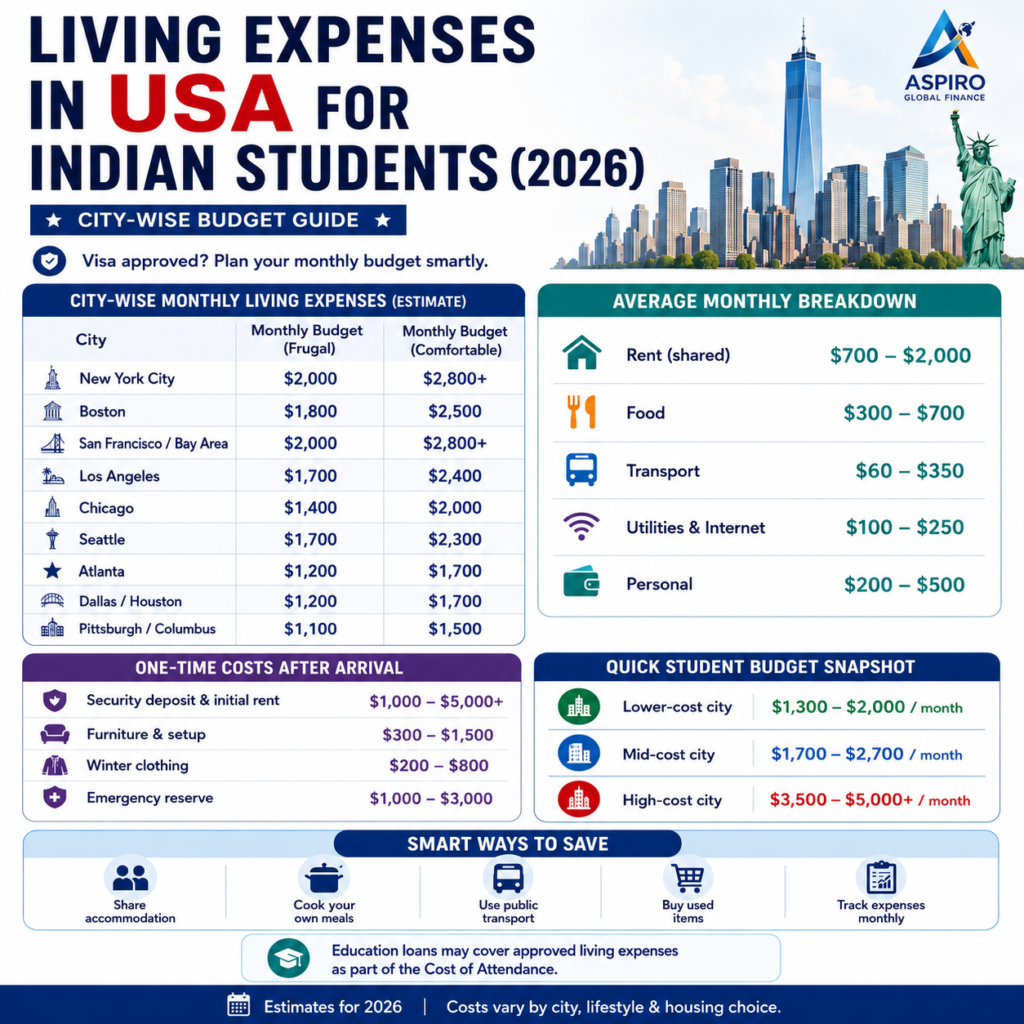
The average monthly living expenses in USA for Indian students fall between $1,200 and $2,500, excluding tuition. That is approximately ₹1,00,000 to ₹2,10,000 per month.
Here is the city-wise summary before we go deep:
| City | Monthly Budget (Frugal) | Monthly Budget (Comfortable) | Annual Living Cost |
|---|---|---|---|
| New York City | $2,000 | $2,800+ | $24,000–$33,600 |
| Boston | $1,800 | $2,500 | $21,600–$30,000 |
| San Francisco / Bay Area | $2,000 | $2,800+ | $24,000–$33,600 |
| Los Angeles | $1,700 | $2,400 | $20,400–$28,800 |
| Chicago | $1,400 | $2,000 | $16,800–$24,000 |
| Seattle | $1,700 | $2,300 | $20,400–$27,600 |
| Atlanta | $1,200 | $1,700 | $14,400–$20,400 |
| Dallas / Houston | $1,200 | $1,700 | $14,400–$20,400 |
| Pittsburgh / Columbus | $1,100 | $1,500 | $13,200–$18,000 |
Figures are living expenses only. Tuition is separate and covered by your education loan.
Note on your loan: If you have taken a US cosigner education loan through Aspiro Global Finance, your loan covers the full Cost of Attendance — tuition, living expenses, and miscellaneous costs — as certified by your university. There is no upper cap. For a full explanation of how US cosigner loans work, read our US Co-Signer Education Loan Guide.
The 5 Categories of Living Expenses in USA for Indian Students
Every dollar you spend as an Indian student in the USA falls into one of these five buckets. Understanding each one gives you control over your total monthly cost of living in USA.
1. Housing — The Largest Component of Your Living Expenses in USA
Housing typically accounts for 40–55% of total monthly living expenses in USA for Indian students. This is the number that matters most when choosing between cities.
Option A: On-Campus Dormitory
The easiest choice for your first semester. Close to campus, fully furnished, utilities included — no lease admin, no furniture shopping. The tradeoff is cost: on-campus dorms run $900–$1,500 per month, often bundled with a mandatory meal plan that adds another $400–$600.
Dorms are the most expensive housing per square foot but eliminate every logistical headache in your first few months in a new country.
Option B: Off-Campus Shared Apartment (Most Popular)
After the first semester, most Indian students move into a shared 2BHK or 3BHK with 2–4 roommates. Your per-person share works out to $600–$1,200 per month depending on the city — significantly cheaper than a dorm. Most Indian students find roommates through Facebook Groups, Sulekha, and university housing boards.
Option C: University-Affiliated Off-Campus Housing
Some universities manage apartment-style housing just off campus, costing $900–$1,300 per month. Partially furnished, more privacy than a dorm, less admin than a private lease. Worth checking your university’s housing office.
One cost most guides skip: When you sign a US lease, you pay first month’s rent + security deposit (one month’s rent) upfront. That means $1,200–$2,400 ready before you even unpack. This must be in your pre-departure financial plan.
2. Food — Where Indian Students Save the Most
Food is the category where Indian students have the clearest advantage over other international students: we know how to cook, and we actively seek out Indian grocery stores.
Cooking at home: $200–$350/month
Students who cook most meals at home spend $200–$350 per month on groceries. The key is knowing where to shop:
- Walmart, Aldi, Trader Joe’s — best for everyday staples, dairy, vegetables
- Indian grocery stores (Patel Brothers, India Bazaar, local desi stores) — rice, dal, atta, spices, frozen Indian snacks at prices 30–50% lower than mainstream supermarkets. A 20 lb bag of rice costs $15–$25. Dal is $3–$6 per pound.
- Costco / Sam’s Club — excellent for bulk buying; split a $65/year membership across 3–4 roommates
A typical home-cooked dal-chawal-sabzi dinner costs $2–$3 per person. Compare that to $15–$25 eating out near campus.
Eating out: $100–$200/month additional
Eating out in the USA costs more than the menu price — tipping is expected at 18–22% on top of every sit-down meal. A $15 dish becomes $18–$19. Most Indian students budget $100–$200/month for occasional eating out.
Monthly food summary:
- Cooking at home (mostly): $250–$350/month
- Mix of cooking + occasional eating out: $350–$500/month
- Eating out regularly: $500–$700+/month
3. Transportation — Depends on Your City
Transportation is the category of living expenses in USA for Indian students that varies the most by city.
Public-transit cities (NYC, Boston, Chicago, San Francisco, Seattle, Philadelphia)
Monthly transit pass costs in 2026:
- New York City (MTA Subway + Bus): $132/month — unlimited rides across all boroughs (Source: MTA.info)
- Chicago (CTA): $33/month student pass; $105 regular monthly pass (Source: transitchicago.com)
- Boston (MBTA): $90–$130/month depending on zones
- San Francisco (BART + Muni): $100–$140/month
- Philadelphia (SEPTA): $96/month unlimited
Most systems offer 25–50% student discounts when you register with your university ID.
Car-dependent cities (Dallas, Houston, Atlanta, suburban USA)
Public transit in Texas and much of the South is limited. A car is close to essential. Monthly car-related costs:
- Car insurance: $100–$200/month (higher for new drivers without a US credit history)
- Gas: $60–$120/month
- Parking: $30–$100/month
Total: $190–$420/month. Many students avoid car ownership in Year 1 by carpooling with Indian classmates or budgeting $80–$150/month for Uber/Lyft + cycling for shorter trips.
4. Health Insurance — Non-Negotiable Living Expense in USA
Healthcare in the USA is extremely expensive without insurance. A single emergency room visit can cost $3,000–$10,000 out of pocket. According to USCIS F-1 visa guidelines, health insurance is effectively mandatory for all F-1 students.
University health plan: $125–$250/month (most comprehensive, automatically accepted at campus clinics)
Private international student insurance: $30–$75/month for basic F-1-compliant plans (IMG Student Journey, WorldTrips StudentSecure, Patriot Exchange)
Our recommendation for Year 1: Pay for the university plan. The access to campus health centres and admin simplicity is worth the premium. Re-evaluate in Year 2 based on your usage.
5. Miscellaneous Living Expenses in USA
This is the category most Indian students underbudget. Here is what lives here:
| Expense | Monthly Cost |
|---|---|
| Phone plan (T-Mobile / Mint Mobile) | $25–$50 |
| Internet (off-campus, split with roommates) | $15–$25 per person |
| Utilities — electricity, gas, water (split) | $40–$100 per person |
| Laundry (shared laundry room) | $15–$25 |
| Personal care (toiletries, haircut) | $30–$60 |
| Clothing (average, higher in first months) | $30–$80 |
| Entertainment, streaming, social | $50–$150 |
| Total miscellaneous | $205–$490 |
First-month one-time setup cost: Budget an extra $200–$400 for mattress, pillow, cookware, and bedsheets when moving into an unfurnished apartment.
City-Wise Living Expenses in USA for Indian Students
New York City
Top universities: Columbia, NYU, Fordham, CUNY, Pace
New York City has the highest living expenses in USA for Indian students among all major cities — but also the strongest career network, internship pipeline, and post-graduation job market.
Rent per person in a shared apartment: $1,200–$1,800/month (Brooklyn, Queens, Jersey City are cheaper than Manhattan). The silver lining: NYC has the best public transit in the USA — a $132 monthly MetroCard covers everything.
Indian grocery stores are abundant across Jackson Heights (Queens), Jersey City, and Hicksville — dal, atta, and Indian vegetables at Indian prices.
| Expense | Monthly Range |
|---|---|
| Rent (shared apartment) | $1,200–$1,800 |
| Food (home-cooked + occasional eating out) | $350–$500 |
| Transit (unlimited MetroCard) | $132 |
| Health insurance | $100–$250 |
| Phone + utilities | $60–$100 |
| Miscellaneous | $100–$200 |
| Total monthly living expenses in USA | $1,942–$2,982 |
Bottom line: Budget $2,000–$2,500/month minimum. The career premium often justifies the cost premium.
Boston
Top universities: MIT, Harvard, Northeastern, Boston University, Tufts
Boston is among the most expensive student cities in the world. Shared apartments in Allston, Brighton, Somerville, and Cambridge run $1,200–$1,600/month per person. MBTA monthly pass: $90–$130. Winters are harsh — budget extra for heating and winter clothing from November to March.
| Expense | Monthly Range |
|---|---|
| Rent (shared apartment) | $1,200–$1,600 |
| Food | $300–$450 |
| Transit (MBTA) | $90–$130 |
| Health insurance | $100–$250 |
| Phone + utilities | $70–$120 |
| Miscellaneous | $100–$200 |
| Total monthly living expenses in USA | $1,860–$2,750 |
Bottom line: Budget $1,900–$2,400/month. Northeastern co-op students can offset significantly through paid work terms.
San Francisco / Bay Area
Top universities: UC Berkeley, Stanford, San Jose State, UC Davis, USF
Bay Area rents are among the highest in the USA, driven by tech industry demand. Students find affordable shared rooms in Oakland, El Cerrito, and Richmond ($900–$1,400/person). BART monthly passes run $100–$140 depending on zones.
| Expense | Monthly Range |
|---|---|
| Rent (shared apartment) | $1,000–$1,700 |
| Food | $300–$450 |
| Transit (BART/Muni) | $100–$140 |
| Health insurance | $100–$250 |
| Phone + utilities | $60–$110 |
| Miscellaneous | $100–$200 |
| Total monthly living expenses in USA | $1,660–$2,850 |
Bottom line: Budget $1,800–$2,500/month. Students in tech programs often offset through CPT internships paying $4,000–$8,000/month.
Los Angeles
Top universities: USC, UCLA, Caltech, LMU, Cal State LA
LA is sprawling and partially car-dependent. Shared apartments in Koreatown, West Adams, and Palms run $900–$1,400/month per person. Weather is mild year-round, reducing utility and clothing costs compared to East Coast cities.
| Expense | Monthly Range |
|---|---|
| Rent (shared apartment) | $900–$1,400 |
| Food | $300–$450 |
| Transit / ride costs | $100–$200 |
| Health insurance | $100–$250 |
| Phone + utilities | $60–$100 |
| Miscellaneous | $100–$200 |
| Total monthly living expenses in USA | $1,560–$2,600 |
Bottom line: Budget $1,600–$2,200/month. LA’s entertainment culture makes overspending easy — set a firm discretionary cap.
Chicago
Top universities: University of Chicago, Northwestern, UIC, IIT, DePaul
Chicago offers the best cost-to-opportunity ratio among major US cities for Indian students. Shared apartments in Hyde Park, Wicker Park, and Rogers Park run $700–$1,100/month per person. Devon Avenue on the North Side is one of the most famous Indian commercial streets in the USA — groceries, restaurants, and tailors at near-India prices.
CTA student monthly pass: just $33/month. Winters are severe — budget $150–$200 one-time for a proper coat and boots.
| Expense | Monthly Range |
|---|---|
| Rent (shared apartment) | $700–$1,100 |
| Food | $280–$420 |
| Transit (CTA student pass) | $33–$105 |
| Health insurance | $100–$250 |
| Phone + utilities | $60–$120 |
| Miscellaneous | $80–$150 |
| Total monthly living expenses in USA | $1,253–$2,145 |
Bottom line: Budget $1,400–$1,900/month. Chicago is the best-value major city for Indian students in the USA.
Seattle
Top universities: University of Washington, Seattle University
Seattle’s tech sector (Amazon, Microsoft, Google) makes it one of the best cities for CS and engineering internships. Shared apartments in Capitol Hill, Fremont, and Beacon Hill run $900–$1,400/month per person.
Washington state has no state income tax — your part-time earnings go further here than in California or New York.
| Expense | Monthly Range |
|---|---|
| Rent (shared apartment) | $900–$1,400 |
| Food | $300–$430 |
| Transit (ORCA card) | $80–$130 |
| Health insurance | $100–$250 |
| Phone + utilities | $60–$110 |
| Miscellaneous | $100–$180 |
| Total monthly living expenses in USA | $1,540–$2,500 |
Bottom line: Budget $1,600–$2,200/month. High internship pipeline at Amazon and Microsoft makes Seattle a strong ROI city for tech students.
Atlanta
Top universities: Georgia Tech, Emory, Georgia State, Kennesaw State
Atlanta consistently ranks among the most affordable major cities for living expenses in USA for Indian students. Shared apartments near Georgia Tech and Emory run $600–$1,000/month per person.
The Indian community in Atlanta is large, growing, and well-organised. MARTA metro covers downtown and the airport, but most student neighbourhoods need a car or reliable rideshare arrangement.
| Expense | Monthly Range |
|---|---|
| Rent (shared apartment) | $600–$1,000 |
| Food | $250–$380 |
| Transport (car or rideshare) | $100–$250 |
| Health insurance | $100–$250 |
| Phone + utilities | $60–$100 |
| Miscellaneous | $80–$150 |
| Total monthly living expenses in USA | $1,190–$2,130 |
Bottom line: Budget $1,300–$1,700/month. Georgia Tech + low living cost is one of the best value combinations in US higher education.
Dallas and Houston
Top universities: UT Dallas, UT Arlington, Rice University, University of Houston, SMU
Texas cities offer the lowest living expenses in USA for Indian students among major metros. Shared apartments in Richardson (near UT Dallas), Plano, and Sugar Land (near Houston) run $550–$900/month per person.
Both cities are car-dependent. The Indian community in DFW and Houston is enormous — you will find every Indian grocery chain, restaurant, and cultural association you need.
Texas has no state income tax, which boosts take-home pay from part-time work significantly.
| Expense | Monthly Range |
|---|---|
| Rent (shared apartment) | $550–$900 |
| Food | $230–$370 |
| Transport (car running costs) | $150–$300 |
| Health insurance | $100–$250 |
| Phone + utilities | $60–$100 |
| Miscellaneous | $70–$130 |
| Total monthly living expenses in USA | $1,160–$2,050 |
Bottom line: Budget $1,200–$1,600/month. The lowest living expenses in USA for Indian students, with a massive desi support network.
Offsetting Living Expenses in USA: Part-Time Work for Indian Students
Most Indian students on an F-1 visa work part-time to offset their monthly living expenses in USA. According to USCIS regulations, F-1 students may work up to 20 hours per week on campus during the semester and 40 hours per week during official breaks.
Typical on-campus earnings (2026):
| Job Type | Hourly Rate | Monthly Take-Home (20 hrs/week) |
|---|---|---|
| Library assistant, dining hall | $12–$16/hr | $800–$1,050 |
| Teaching / Research assistant | $15–$22/hr | $1,000–$1,400 |
| IT support, lab technician | $15–$22/hr | $1,000–$1,400 |
At $15/hour for 20 hours/week, you earn roughly $1,200/month gross, approximately $1,000–$1,050 after federal and state taxes.
According to Bureau of Labor Statistics data, state minimum wages in 2026 range from $7.25 (federal floor) to $17/hour in California, New York, and Washington — which is why part-time earnings vary significantly by state.
CPT internships from Year 2 onward: Technology internships under CPT authorisation pay $25–$50/hour, translating to $4,000–$8,000/month during full-time summer placements — which fundamentally changes the financial equation for STEM students.
Does Your Education Loan Cover Living Expenses in USA?
Yes — completely.
This is one of the most commonly misunderstood aspects of US education loans. Your loan does not just cover tuition. The Cost of Attendance (COA) certified by your university includes:
- Full tuition fees for your programme
- On-campus or off-campus accommodation
- Food and meal costs
- Transportation
- Health insurance
- Personal and miscellaneous expenses
There is no upper cap on the loan amount. You borrow exactly what your university certifies as your Cost of Attendance.
At Aspiro Global Finance, we specialise in US cosigner education loans with interest rates starting at 2.79% — significantly lower than Indian bank loans or non-cosigner international loans. The loan covers all the living expenses in USA that this guide has detailed.
For a complete explanation of how US cosigner loans work, eligibility, and the application process, read our US Co-Signer Education Loan Guide.
To understand how US cosigner loans compare to Indian bank loans and no-cosigner options, read: US Co-Signer Loan vs Indian and No-Co-Signer Loans.
For students preparing financial documentation before departure — including how lenders view bank balance vs education loan for your visa — read: Proof of Funds for USA Visa: Bank Balance vs Education Loan.
Pre-Departure Financial Checklist for Indian Students
Before your flight, confirm every item on this list:
- First month’s rent + security deposit ready — $1,200–$2,400 depending on city (check if loan disbursement timeline covers this)
- $500–$1,000 cash or accessible card for first-week expenses (groceries, transport, SIM, bedding)
- US bank account plan confirmed — most universities help during orientation. Use Wise or Remitly for rupee-to-dollar transfers from India
- Health insurance status confirmed — know whether your university plan starts on enrollment day or if you need bridging coverage
- International card activated — Niyo Global or HDFC Forex cards are popular among Indian students for USD spending without heavy forex fees
- Six months of living expenses verified — confirm loan disbursement timeline aligns with semester start date
- Indian grocery store identified in your city — Patel Brothers, India Bazaar, or local equivalent. Most cities with large Indian student populations have at least one within driving distance of campus
Frequently Asked Questions on Living Expenses in USA for Indian Students
Q: What is the average monthly living expenses in USA for Indian students in 2026? Between $1,200 and $2,500 per month excluding tuition, depending on city and lifestyle. Budget cities like Dallas and Houston sit at $1,200–$1,600; expensive cities like New York and Boston sit at $2,000–$2,500. According to the Institute of International Education’s Open Doors report, over 330,000 Indian students were enrolled in US universities in 2025–26, making cost planning more important than ever.
Q: Which city has the lowest living expenses in USA for Indian students? Dallas and Houston consistently offer the lowest costs, with shared apartment rents of $550–$900/month per person. Pittsburgh and Columbus are even cheaper but have smaller Indian communities and fewer internship opportunities.
Q: Can I cook Indian food easily in the USA? Yes. Major cities have Indian grocery stores (Patel Brothers, India Bazaar) where rice, dal, atta, and spices are available at 30–50% lower prices than mainstream supermarkets. A home-cooked Indian meal costs $2–$3 per person.
Q: Do I need a car in the USA? Depends on your city. In NYC, Boston, Chicago, and San Francisco — no. In Dallas, Houston, Atlanta, and most of suburban USA — almost certainly yes, unless you have reliable carpooling.
Q: Does my US education loan cover living expenses? Yes. US cosigner education loans cover your full Cost of Attendance — tuition, rent, food, transport, insurance, and miscellaneous expenses — as certified by your university. There is no upper cap on the loan amount.
Q: Will having a US education loan affect my F-1 visa interview? No. A confirmed loan approval does not negatively impact your F-1 visa application. In fact, a loan sanction letter from a recognised US lender is strong financial proof during the visa interview and can strengthen your application. According to USCIS, F-1 applicants must demonstrate sufficient financial support — and a US cosigner loan letter directly satisfies this requirement.
Q: How much should I budget extra for the first month? Add $500–$800 to your regular monthly budget for first-month one-time costs: security deposit (if not covered by loan disbursement timing), bedding and cookware for a new apartment, winter clothing for cold cities, and airport-to-accommodation transport.
Q: What part-time work can I do to offset my living expenses in USA? F-1 students can work up to 20 hours/week on campus during the semester (library, research assistant, IT support at $12–$22/hour) and 40 hours/week during breaks. Off-campus CPT internships from Year 2 can pay $25–$50/hour in tech fields. See USCIS student work authorisation rules for full eligibility details.
Final Word: Plan Your Living Expenses in USA Before You Land
The students who struggle financially in the USA are almost never the ones who run out of money — they are the ones who land without a plan and spend the first two months in reactive mode.
If you know your city, your accommodation type, your exact monthly budget for living expenses in USA, and your loan disbursement timeline before you board the flight — the first semester becomes about academics and experience, not financial anxiety.
At Aspiro Global Finance, we help Indian students with the full financial picture — not just the loan, but also which lender fits your profile, how much to borrow, what your monthly cash flow looks like semester by semester, and how to plan so the money is in your account before classes begin.
If you have your admit letter and want to understand how a US cosigner loan can cover your tuition and living expenses in USA, send us a message on WhatsApp or Instagram. We respond within 24 hours — no fee, no obligation.
Related Reading from Aspiro Global Finance
- US Co-Signer Education Loan Guide — How US cosigner loans work, who qualifies as a cosigner, interest rates from 2.79%, and the full application process
- US Co-Signer Loan vs Indian and No-Co-Signer Loans — A detailed comparison of all three loan types: interest rates, collateral, loan caps, and which is best for your profile
- Proof of Funds for USA Visa: Bank Balance vs Education Loan — What the US consulate actually wants to see as financial proof, and how your loan letter satisfies it
- I-20 Amount Explained — Understand how universities calculate your I-20 amount and how much funding you need before applying for your visa.
- MBA Loan Guide 2026 — Explore funding options for Harvard, Wharton, Stanford, Kellogg, and other leading MBA programs.
- Fall 2026 US Visa Crisis — Understand recent visa rejection trends and practical steps students can take to improve approval chances.
Disclaimer: All figures are 2026 estimates for planning purposes. Actual costs vary based on lifestyle, specific neighborhood, and personal choices. Exchange rate used: 1 USD ≈ ₹93. External links are provided for reference only; Aspiro Global Finance is not responsible for third-party content.